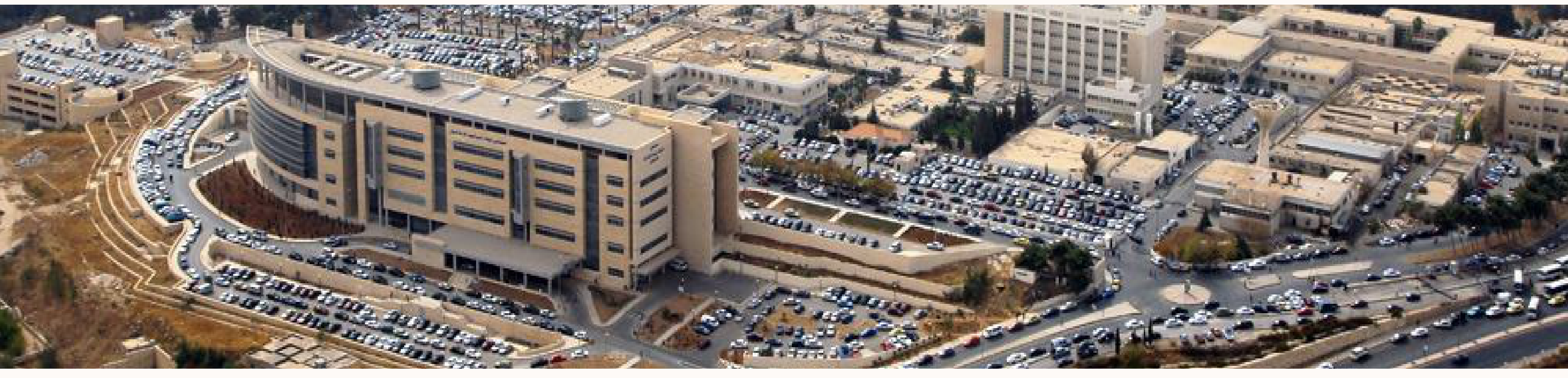
Overview
This project was a six month discovery of the end to end patient journey inside a military medical city. Working alongside a design lead, a business analyst, and a technical lead, we conducted field observations, departmental visits, and system reviews to understand how patients move through insurance, admissions, clinics, diagnostics, and pharmacy.
The goal was to map the actual workflows, identify operational gaps, and build a clear foundation for future digital transformation.
2024 · 6 months
Role
My role covered patient journey documentation and analysis, system evaluation, process mapping, and digital transformation recommendations, using shadowing, interviews, system audits, journey mapping, blueprinting, and document review. Photography wasn't always allowed and recording interviews was prohibited, so paperwork copies were sometimes generated just to understand the process.
The Medical City operates across multiple disconnected systems with heavy reliance on manual paperwork. Patients carry physical documents between departments, lab and radiology results are printed on paper, and processes are fragmented across incompatible digital platforms, creating delays, redundant data entry, and friction at every touchpoint.
From an external perspective, this looked like a straightforward capacity problem: long waits, repeated paperwork, and unclear next steps, with delays assumed to come from volume or staffing. That framing didn't survive contact with the actual system.

Delays weren't caused by a single bottleneck. Patient journeys were prolonged by an accumulation of small delays across departments, many running on outdated or disconnected systems. Patients frequently acted as intermediaries, carrying paper forms, approvals, and test results between units, while staff relied on manual workarounds like phone calls, paper logs, and personal follow-ups to bridge systems that didn't talk to each other.
Decisions made in inventory, tenders, and finance directly shaped the patient experience, despite being invisible to patients. What looked like a slow hospital was, in reality, a complex system of fragmented tools and dependencies.
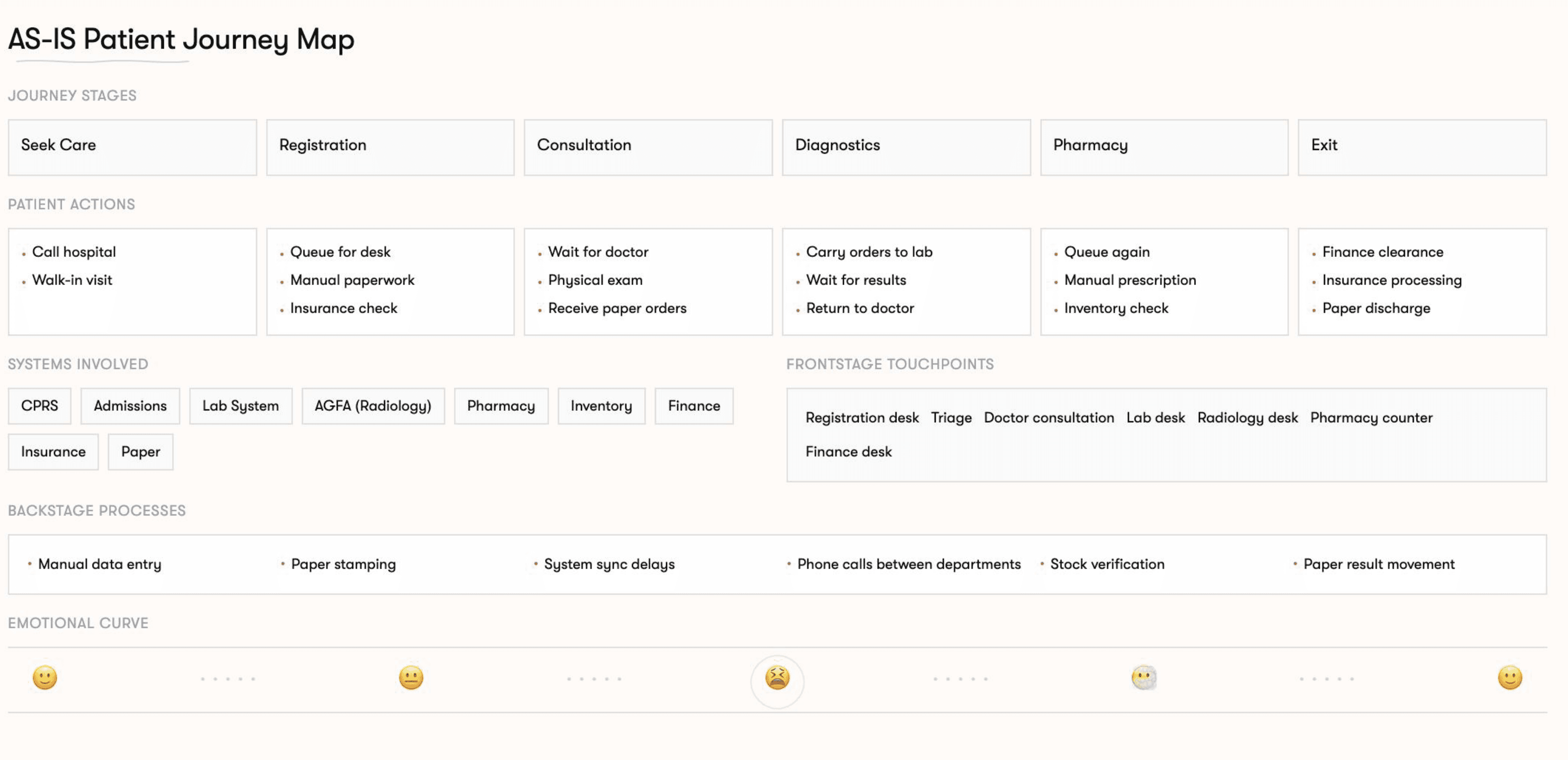
Mapping the AS-IS patient journey end to end, across seeking care, registration, consultation, diagnostics, pharmacy, and exit, made the fragmentation visible in one view: the systems, touchpoints, and backstage processes behind every step, and where the emotional curve dipped hardest.
A few findings stood out. Systems like CPRS, AGFA, and the lab and pharmacy platforms don't communicate in real time, so critical data needs manual re-entry and there's no unified patient record. Each handoff between departments adds waiting time, stretching an average visit by two to three unnecessary hours. Pharmacy has no visibility into real-time stock, which leads to delays or substitutions. And patients often become the messengers, physically carrying orders and results between departments, adding twenty to forty minutes per transition.
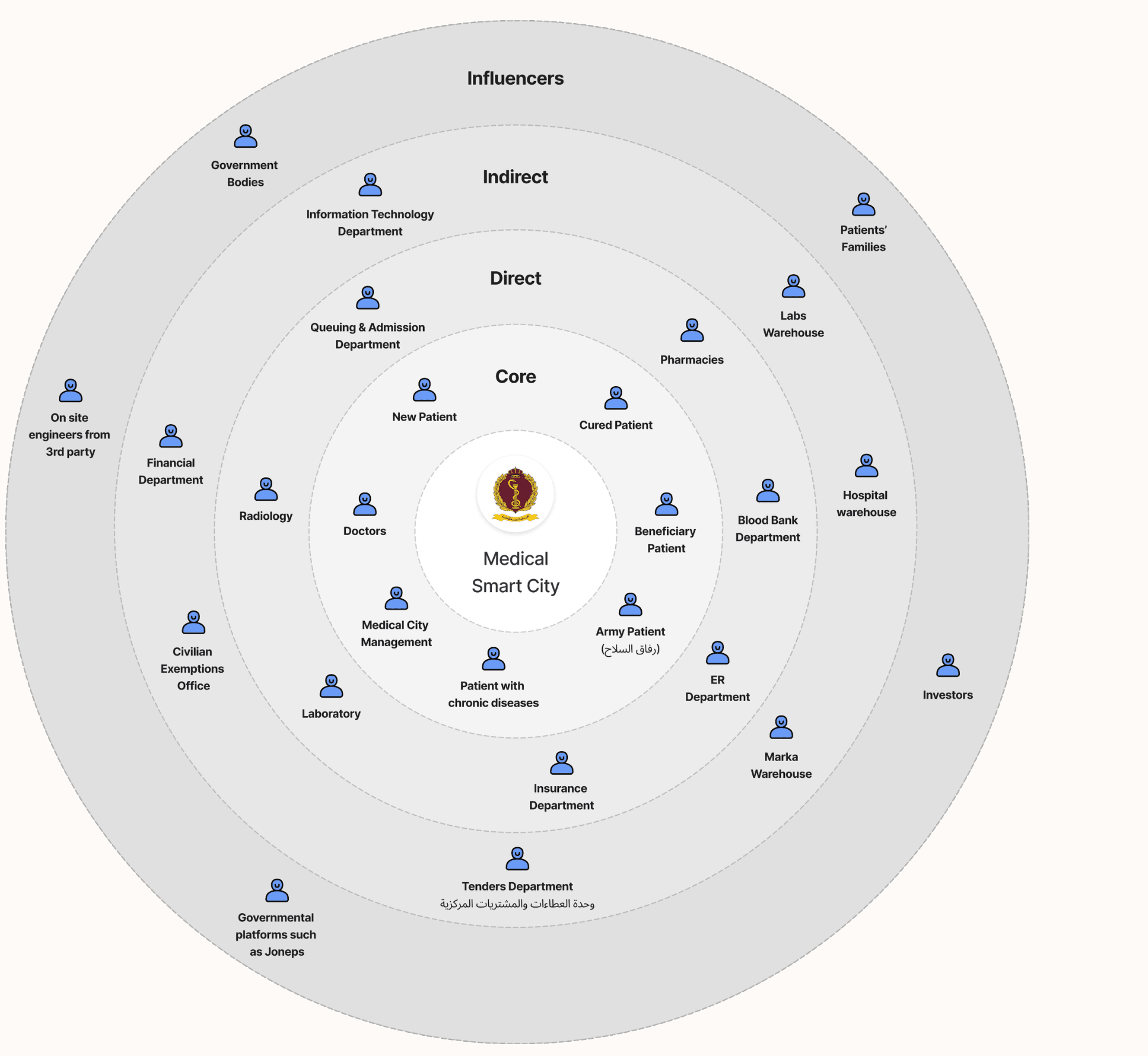
Beyond direct clinical care, a wide set of actors shape the patient journey, from financial and IT departments to warehouses, insurance, and government platforms. Mapping core, direct, indirect, and influencer stakeholders showed how non-clinical departments and external bodies contribute to delays and service outcomes, and helped ensure the recommendations addressed systemic issues rather than isolated touchpoints.
The roadmap was phased to match what the institution could realistically absorb. In the short term (zero to six months): digitising approval workflows, standardising order forms across departments, giving pharmacy visibility into inventory, and adding SMS or app notifications for diagnostics.
In the medium term (six to eighteen months): integrating CPRS with radiology and lab systems, creating unified patient record access, deploying digital check-in kiosks, and moving to electronic prescriptions.
Longer term (eighteen months and beyond): full system interoperability, mobile tools for clinical staff, automated discharge and follow-up scheduling, and digitising the blood bank and inventory management.
Systems thinking at scale mattered most here. No single touchpoint exists in isolation, every patient interaction depends on invisible backstage processes and system integrations across a large, tightly constrained organisation.
Working within a military medical environment with legacy systems and procurement restrictions meant solutions had to stay pragmatic, phased, and respectful of existing institutional knowledge, not just technically correct.
Service blueprints and journey maps ended up being the real communication tools, translating between clinical staff, IT teams, and hospital leadership who each needed the same findings framed differently.
Let's make something great!